
The Collection
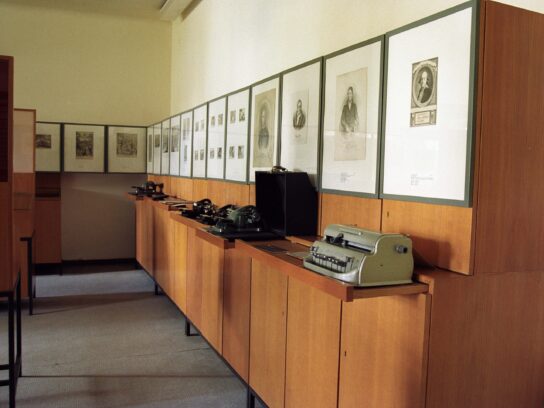
The world’s oldest collection on the history of education for the blind showcases historical teaching aids and assistive devices. Established in the 1830s, the collection documents the development of education for the blind in Vienna. It features teaching materials for music, mathematics and biology, as well as the evolution of writing systems for the blind, culminating in Braille.
The collection is not open to the public; visits are only possible by prior appointment.

The Vienna Institute for the Blind
In 1804, Johann W. Klein began teaching in his private home. The growing number of pupils led to state support in 1808. In 1816, the institute became a state institution, later known as the ‘Imperial and Royal Institute for the Education of the Blind’. After the Second World War, it became the “Federal Institute for the Education of the Blind”.
The institute moved several times and has been located at Wittelsbachstraße 5 since 1898. The building was destroyed in 1945 and rebuilt by 1958

Johann Wilhelm Klein (1765–1848)
In 1804, Klein founded the first institute for the blind in the German-speaking world with his pupil Jakob Braun. His aim was to integrate blind people into society through schooling and vocational training. This was followed in 1826 by a workshop for blind adults. In 1819, he wrote the “Textbook for the Instruction of the Blind”. He died in Vienna in 1848.
Louis Braille
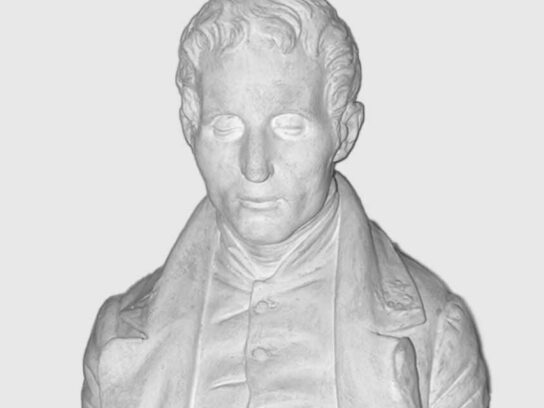
Louis Braille attended the Paris Institute for the Blind from 1819 onwards and, in 1825, improved upon a tactile ‘night writing’ system devised by Charles Barbier. His 6-dot system allows for 63 combinations and covers letters, numbers and musical notation. In 1873, Braille became the established standard and is now essential for blind people worldwide.